

Introducing configurable structured form-filling system
Introducing configurable structured form-filling system
Sai Anurag Modalavalasa
Sai Anurag Modalavalasa
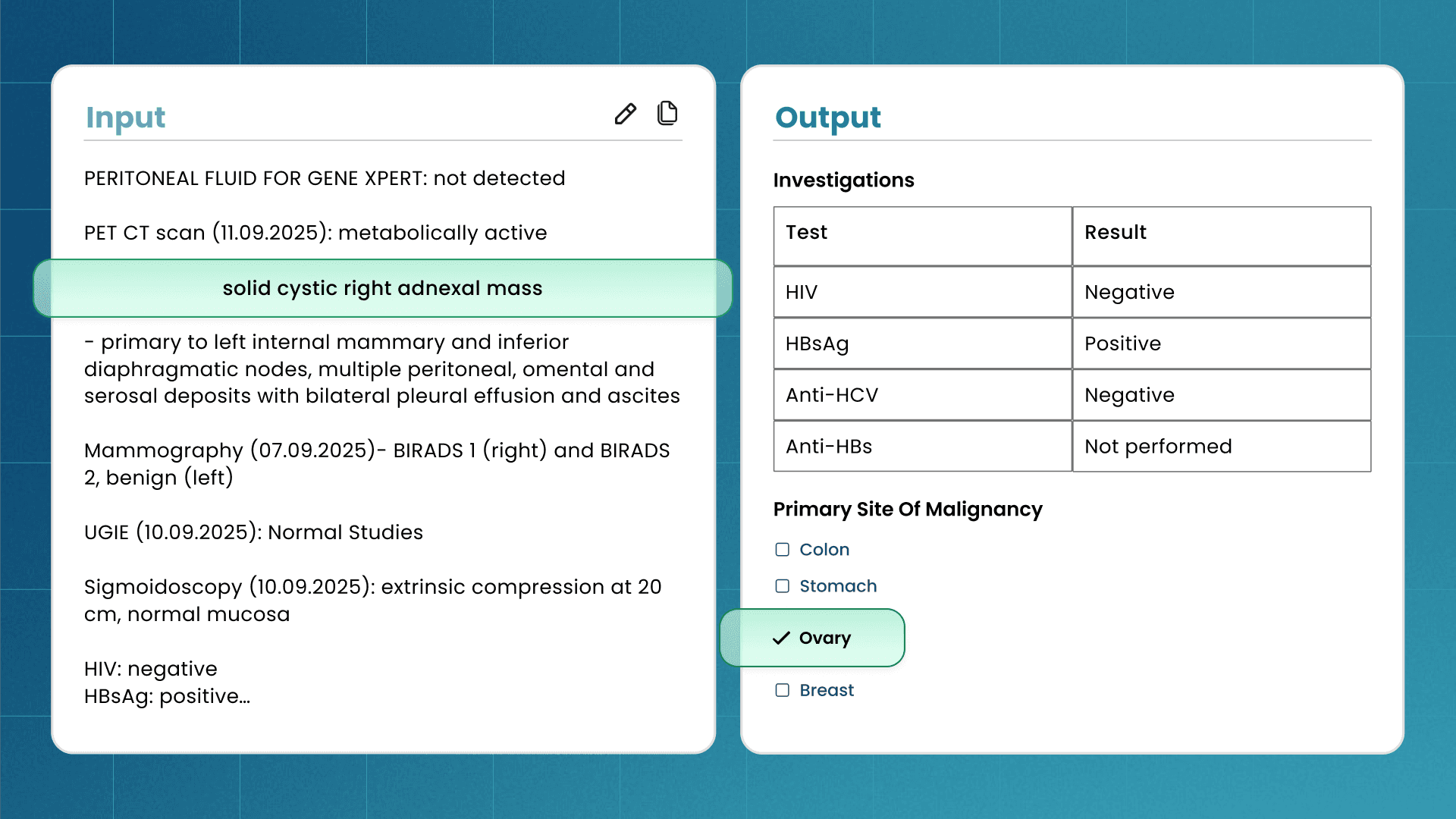
Nature of structured forms used in healthcare systems
Structured data-collection forms are widely used in healthcare, both in clinical-care and research workflows. Specialists use them while processing referral packets during intake while research coordinators use them to capture protocol-specified observations during a clinical trial. Although these forms share the goal of consistent data capture, their structure and completion rules vary widely.
A major source of this variability is the changing nature of information required as care pathways or study protocols evolve. In a clinical trial, for example, Day 1 forms may focus on baseline characteristics, eligibility checks, and initial labs. By Day 21, the required fields often shift to toxicity grading, dose-modification calculations, and response assessments. The forms themselves span various input types, including tables for vitals, multiple-choice fields for study-arm assignment, date pickers for treatment timelines, and free text for clinical impressions. Many fields also require domain-specific instructions (for example, whether body-surface area should be calculated using the DuBois or Mosteller formula). In many cases, forms use conditional logic to determine whether certain fields need to be completed based on predefined criteria.
As a result, any automated form-filling system must be highly configurable across form structure, field types, and domain-specific instructions to meet the requirements of real-world clinical workflows.
Our form-filling system: Design and Capabilities
Configurable Form Specification
Our system provides an interface to enable users to configure structured forms. The attributes users may configure to specify the form include:
Field types: Multiple-choice questions, tables, free-text, dropdowns, and date picker.
Additional instructions: Explicit, domain-specific rules that must be followed during population
Conditional logic: deterministic rules specifying when a field is required, optional, or should be suppressed based on other field values or extracted findings.
Form structure: the ordered sequence of fields and the grouping of fields into sections or subsections.
There is no imposed limit on the number of fields within a form or number of forms users can specify in their account.
Automated Form Filling
The system accepts unstructured inputs (such as clinical documents, transcripts, and free-text notes) and automatically generates structured outputs that conform to the configured form specification. Our system does not impose any limits on the input size. For tasks requiring long-context handling, we use agentic frameworks to segment documents, persist contextual memory across sections, and orchestrate multi-step rollouts at inference time.
During inference, the system incorporates several layers of validation and control:
Safety checks: datatype validation, enforcement of conditional logic, and verification that field-level instructions are followed.
Output validators: detectors for low-confidence extractions and for outputs that deviate from the specified constraints. These validators prune or flag non-compliant outputs.
Fallback systems: Independent implementations invoked when the output of the primary system is flagged during safety checks or output validation.
This architecture enables the system to handle substantial input variability while consistently generating accurate, specification-compliant outputs.
This system is designed to overcome the limitations of chat interfaces and facilitate automation of repetitive workflows that rely on structured forms, such as case-report forms, disease registries, or referral-intake processing. It also enables users to configure and deploy new forms instantly. To try this feature, log in to your account and follow the links below:
If you have any questions, you may contact us at fosterhealth.ai@gmail.com.
Nature of structured forms used in healthcare systems
Structured data-collection forms are widely used in healthcare, both in clinical-care and research workflows. Specialists use them while processing referral packets during intake while research coordinators use them to capture protocol-specified observations during a clinical trial. Although these forms share the goal of consistent data capture, their structure and completion rules vary widely.
A major source of this variability is the changing nature of information required as care pathways or study protocols evolve. In a clinical trial, for example, Day 1 forms may focus on baseline characteristics, eligibility checks, and initial labs. By Day 21, the required fields often shift to toxicity grading, dose-modification calculations, and response assessments. The forms themselves span various input types, including tables for vitals, multiple-choice fields for study-arm assignment, date pickers for treatment timelines, and free text for clinical impressions. Many fields also require domain-specific instructions (for example, whether body-surface area should be calculated using the DuBois or Mosteller formula). In many cases, forms use conditional logic to determine whether certain fields need to be completed based on predefined criteria.
As a result, any automated form-filling system must be highly configurable across form structure, field types, and domain-specific instructions to meet the requirements of real-world clinical workflows.
Our form-filling system: Design and Capabilities
Configurable Form Specification
Our system provides an interface to enable users to configure structured forms. The attributes users may configure to specify the form include:
Field types: Multiple-choice questions, tables, free-text, dropdowns, and date picker.
Additional instructions: Explicit, domain-specific rules that must be followed during population
Conditional logic: deterministic rules specifying when a field is required, optional, or should be suppressed based on other field values or extracted findings.
Form structure: the ordered sequence of fields and the grouping of fields into sections or subsections.
There is no imposed limit on the number of fields within a form or number of forms users can specify in their account.
Automated Form Filling
The system accepts unstructured inputs (such as clinical documents, transcripts, and free-text notes) and automatically generates structured outputs that conform to the configured form specification. Our system does not impose any limits on the input size. For tasks requiring long-context handling, we use agentic frameworks to segment documents, persist contextual memory across sections, and orchestrate multi-step rollouts at inference time.
During inference, the system incorporates several layers of validation and control:
Safety checks: datatype validation, enforcement of conditional logic, and verification that field-level instructions are followed.
Output validators: detectors for low-confidence extractions and for outputs that deviate from the specified constraints. These validators prune or flag non-compliant outputs.
Fallback systems: Independent implementations invoked when the output of the primary system is flagged during safety checks or output validation.
This architecture enables the system to handle substantial input variability while consistently generating accurate, specification-compliant outputs.
This system is designed to overcome the limitations of chat interfaces and facilitate automation of repetitive workflows that rely on structured forms, such as case-report forms, disease registries, or referral-intake processing. It also enables users to configure and deploy new forms instantly. To try this feature, log in to your account and follow the links below:
If you have any questions, you may contact us at fosterhealth.ai@gmail.com.