

Foster wins India AI’s CATCH Grant
Foster wins India AI’s CATCH Grant
Anukriti Chaudhari
Anukriti Chaudhari
One in Nine Indians is likely to develop cancer during their lifetime [1]. It is estimated that there are 1.45 million new cancer cases per year in India [2,3]. Studies indicate that the new cancer caseload per medical oncologist in India is an order of magnitude higher than in High Income Countries (HICs). Late presentation of disease (~87% of patients seek medical care in advanced stages of disease), inability to afford expensive treatment, and high patient volume per provider contribute to India’s mortality-incidence ratio of 0.68. This is significantly higher than the mortality-incidence ratio of 0.38 in HICs [2]. Furthermore, access to cancer care in India remains highly inequitable. Most cancer care centers are located in major cities while ~70% of Indians live in rural areas. Consequently, patients travel thousands of kilometers to get cancer care. ~60% of new patients in Tata Memorial Hospital, Mumbai come from other parts of India outside Maharashtra [3]. Multiple oncologists in India have identified leveraging technology as a top priority to improve cancer control in India [4].
The National Cancer Grid (a network of more than 360 cancer care centers that treats ~60% of new cancer cases across India [5]), Koita Centre for Digital Oncology (KCDO) [6], India AI (part of the Ministry of Electronics and Information Technology (MeitY)) launched the Cancer AI & Technology Challenge (CATCH) grant to leverage AI and improve cancer control in India [7]. CATCH grant’s goal is to catalyze validation, piloting and deployment of AI systems that meaningfully improve cancer care across India. The program is designed to enable development of impactful solutions in early screening, treatment support, patient engagement, and system - level optimization for cancer care.
Winning the CATCH Grant: A validation of our hypothesis, approach and execution
When we started Foster, we hypothesized that AI systems capable of large-scale digitization and reliable automation of clinical data abstraction could improve patient care, enhance operational efficiency, and accelerate research. We closely collaborated with Tata Memorial Hospital to identify gaps and pain-points in cancer care delivery.
Based on these insights, we developed multimodal AI agents that ingest ambient clinical conversations, handwritten notes, and scanned medical records, and convert them into structured digital data. Beyond digitization, these agents perform automated clinical data abstraction across a wide range of use cases, including generation of case report forms (CRFs), disease registry entries, patient summaries, and discharge summaries, addressing critical documentation and data gaps across oncology workflows.
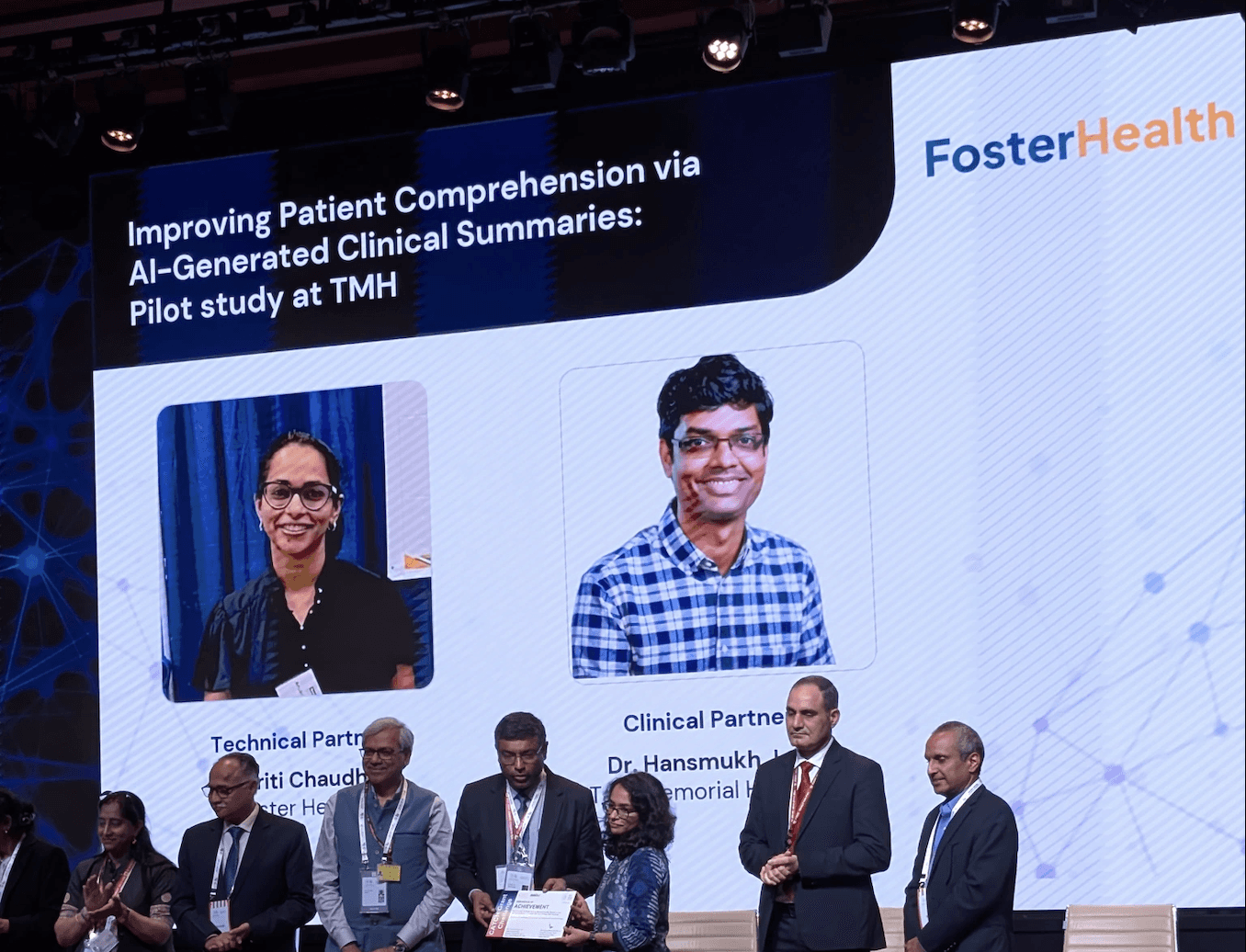
Out of 299 applications, we were selected as one of 10 winners [8,9,10,11,12]. This award validates that the need we are addressing is nationally relevant and that our approach and execution are scalable. It enables us to institutionally ground our innovation, design for scale, and accelerate deployment across the National Cancer Grid’s cancer care centers. We look forward to continuing our collaboration with Tata Memorial Hospital and the National Cancer Grid to build AI systems that meaningfully improve healthcare outcomes.
One in Nine Indians is likely to develop cancer during their lifetime [1]. It is estimated that there are 1.45 million new cancer cases per year in India [2,3]. Studies indicate that the new cancer caseload per medical oncologist in India is an order of magnitude higher than in High Income Countries (HICs). Late presentation of disease (~87% of patients seek medical care in advanced stages of disease), inability to afford expensive treatment, and high patient volume per provider contribute to India’s mortality-incidence ratio of 0.68. This is significantly higher than the mortality-incidence ratio of 0.38 in HICs [2]. Furthermore, access to cancer care in India remains highly inequitable. Most cancer care centers are located in major cities while ~70% of Indians live in rural areas. Consequently, patients travel thousands of kilometers to get cancer care. ~60% of new patients in Tata Memorial Hospital, Mumbai come from other parts of India outside Maharashtra [3]. Multiple oncologists in India have identified leveraging technology as a top priority to improve cancer control in India [4].
The National Cancer Grid (a network of more than 360 cancer care centers that treats ~60% of new cancer cases across India [5]), Koita Centre for Digital Oncology (KCDO) [6], India AI (part of the Ministry of Electronics and Information Technology (MeitY)) launched the Cancer AI & Technology Challenge (CATCH) grant to leverage AI and improve cancer control in India [7]. CATCH grant’s goal is to catalyze validation, piloting and deployment of AI systems that meaningfully improve cancer care across India. The program is designed to enable development of impactful solutions in early screening, treatment support, patient engagement, and system - level optimization for cancer care.
Winning the CATCH Grant: A validation of our hypothesis, approach and execution
When we started Foster, we hypothesized that AI systems capable of large-scale digitization and reliable automation of clinical data abstraction could improve patient care, enhance operational efficiency, and accelerate research. We closely collaborated with Tata Memorial Hospital to identify gaps and pain-points in cancer care delivery.
Based on these insights, we developed multimodal AI agents that ingest ambient clinical conversations, handwritten notes, and scanned medical records, and convert them into structured digital data. Beyond digitization, these agents perform automated clinical data abstraction across a wide range of use cases, including generation of case report forms (CRFs), disease registry entries, patient summaries, and discharge summaries, addressing critical documentation and data gaps across oncology workflows.
Out of 299 applications, we were selected as one of 10 winners [8,9,10,11,12]. This award validates that the need we are addressing is nationally relevant and that our approach and execution are scalable. It enables us to institutionally ground our innovation, design for scale, and accelerate deployment across the National Cancer Grid’s cancer care centers. We look forward to continuing our collaboration with Tata Memorial Hospital and the National Cancer Grid to build AI systems that meaningfully improve healthcare outcomes.